
Edited by Olivia Griffin
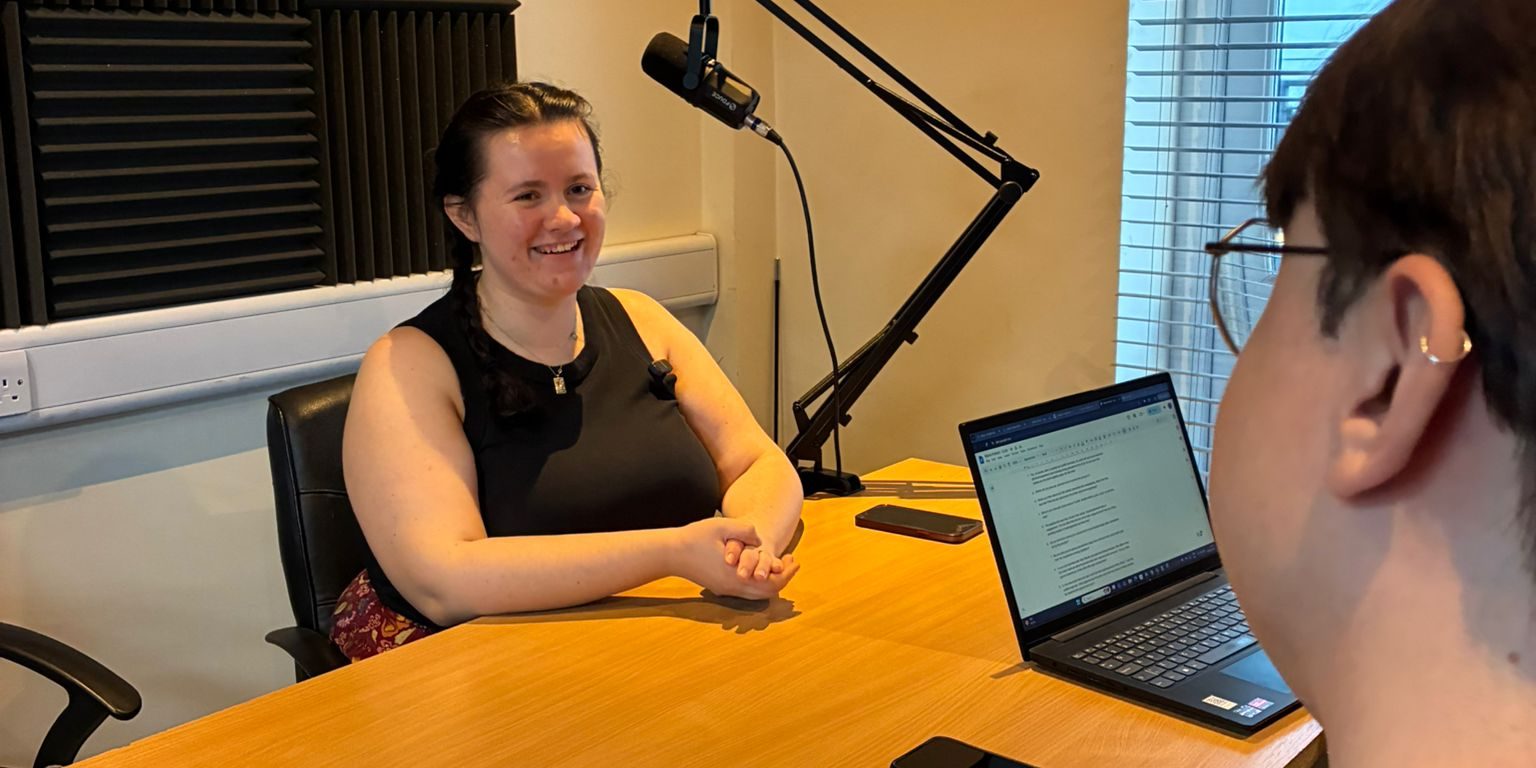
Maria Pollard discusses their 2026 Students’ Union Presidential re-election bid with Deputy Editor Aneurin Davies and Head of Politics Ruaidhrí Gillen Lynch.
Prefer to listen to this interview? Follow @gairrhydd on Instagram for more information.
This interview is published verbatim. Views expressed are those of the candidate and do not necessarily reflect the views of Gair Rhydd or Cardiff Students’ Union.
You were a student of Cardiff University. What did you study and what previous experience, not including being president of the SU currently, do you have that makes you the most suitable option for the role?
Okay, so I studied an undergraduate degree in politics. I didn’t do much British politics. I did lots of stuff on populism, the far right, gender, race, the environment, all that fun stuff. I love my degree. I’ll rave about it. I’ll rave about my department like all the time. They’re phenomenal. And in terms of experience, if we’re barring this year as student president, I was actually student union president of another institution before I started university. I did a sabbatical year at my college. Very different. It was 4,000 students versus 30,000. I was the only sab (sabbatical officer) versus 7. But it was a very interesting role. I redrafted the entire constitution for the SU. I brought in the election system that they’ve got now. So I did that role for a year. Lots of transferable bits and pieces.
I’m used to being in the room with people who expect me to not understand what’s going on then. When I was in university, obviously I’ve been a society president, I’ve been a sports club committee member. So I know what’s going on in sports and societies. I know what student volunteers, student leaders are doing to make sure that all of these clubs are running well. I was then also on the now defunct Scrutiny Committee in my first year as vice chair and then in my second and third year I was chair of student Senate and last year I was chair of Student AGM. So public speaking, chairing meetings, kind of policy stuff in that being really deeply entrenched in the SU. So even pre-being president, I’m not sure there’s much more experience I could have gotten in my three years at university that would be relevant for this job.
Sticking with that. Obviously you spoke about your college experience. Could you tell us, for those who might not know a little bit about your upbringing, the kind of school you went to, those experiences?
I am originally from Swansea. My parents are both university lecturers who are both currently under scope for redundancy. But I went to a state private school, a state primary school. I went to a private school from year 7 to year 11 on a scholarship and a bursary and then I went to a state college for my last two years of school, that was. It was an interesting experience, I think. I’m not sure whether I’m not going to chat class too much, but you know, I was 15 and I was a poor kid in a private school and then I went to state school and I was the rich kid in the state school and it was really quite radicalizing actually. I was like, why did I have a victim complex for five years? So I’ve lived in Wales all my life. I was born in England but moved here three months later. So I very much claim being Welsh. I learned Welsh in school. I used to sing in Welsh choirs.
So when you think about your life outside university and campaigning, what does that look like? How do you spend your time when you’re not organizing?
I play Korfball. I tend to go through kind of periods of time in which I get fixated on various hobbies. So for most of university I was doing stand up comedy. I haven’t quit doing stand up. I’m still doing writing work for the BBC off and on. I’m doing gigs when I can, but at the moment the fixation is Korfball. I’ve decided I want to make the Welsh team in a couple of years. So I play for a local team in the city. I played for Cardiff Uni for three years. I played in the varsity squad. I played for their ones at BUCS. So sport has been. I’m their social sec as well, which is great fun and so I do a lot of that. I love cooking and baking. I love doing dinner parties for my friends. I did a tagine night recently where I made tagine for my friends because I’d been to Morocco and I decided I wanted to learn how to cook their food. I love to bake.
I do a lot of yoga since becoming president. I think that’s probably the main reason why I’ve been sane, which honestly might be because my mum was qualified as a yoga teacher and people bang on about how good yoga is for your well being and blah blah, blah. And you brush it off because you don’t want to believe it and then you start doing it and I’m like, oh my god. I feel a bit more sane now. But I am very much like a jack of all trades when it comes to my hobbies. I’ve been into art. I used to do music, open mics, I will try anything. I’m doing Strictly Come Dance sport with the ballroom society this year. So I’m currently learning to samba as well.
In your announcement post and manifesto, you’ve promised to reform student misconduct procedures so victims aren’t put in the room with their perpetrators. Did a specific event prompt this policy or is it natural evolution from your experiences in the past year as SU president?
Yes, I’m not going to go into it because of student cases and stuff like that, but I did sit on a case in the summer and what I saw was not on and upsetting and it was triggering for me and I wasn’t the victim. So that is something that I’ve been pushing for a while. But also that wasn’t just a one off event because I know from conversations I’ve had with Time to Act and other groups working on tackling sexual misconduct, that the system is becoming too court-like, when it’s not a court case. And I think that the perception among a lot of students is that we currently have a student conduct case that is too harsh on protesters and not harsh enough on perpetrators of sexual violence.
So moving on to your timetabling promises, do you think that your promise to fix timetabling could realistically be achieved by the beginning of the next academic year? How do you intend to make that happen?
I’m already working on it, so that helps. I’d have a run up in terms of work that we’re doing. I sit on other timetabling committees. It is currently looking good for September, but that needs to be pushed more. I think that obviously wanting to get timetables on time is a big part of that policy. But the other thing is also, first of all pushing the university to do a review into what went so wrong. I’ve been pushing for that since the autumn and their response has been that they need to make sure they get it sorted for next year and then they’ll do the review. That’s something I’m going to complete, continue to push for, but then also looking at timetables more holistically, because I don’t think that the only problem with timetabling at Cardiff is that they’re late.
I think that particularly now, more than ever, students are having to work alongside their studies. Are students timetables flexible with work? You know, are they accessible? Are the buildings in the right position and stuff like that so I’m really keen to kind of do a further piece of research on what is an ideal timetable for students, how can we block teaching in the best possible way, stuff like that. And so I’m really keen to kind of use that. Use Speak Week best practice data from other universities and really make it like a big project with the university.
In your manifesto you talk about creating a badge system in the careers fair so students can see what employers are ethical, sustainable or sponsor international students. Some students and candidates could argue that the alternative of cutting unethical companies off from the SU completely would be preferable. And others might agree in principle with your idea but question the metrics which could be used to implement this system and who it would be done by. What would you say to those concerns?
Obviously I want to cut them as well. My personal opinion is that I don’t think that we should be giving a platform to mining companies or to weapons companies in our university careers fairs. Unfortunately, the university has a policy where they have to provide a– I forgot what it was, not like freedom of choice, it’s called something else. But they have a policy in place which is that they have to provide a diverse range of options for students particularly because they have courses that might focus on the mining industries and stuff like that. I did try to lobby to overturn that. I finally managed to get a survey with Students’ Futures surveying students on their opinions on ethical careers. Unfortunately for me, in my opinion, the outcome of the survey was that most students who answered it wanted to see as many options as possible. Even if there are options that people find unethical.
I remember that form. I did it myself.
Yes, I know. Which, you know – frustrating. So this kind of the switch is for me now that this has happened. I don’t have the power to cut these. I can continue to lobby. I’m going to. In the meantime, how do we reward positive stuff happening, ethical, sustainable careers and platform those more so it kind of drowns out the stuff that students don’t like. So the badging system I think is part of that. I think it is kind of a reward. One of the good outcomes from that survey is that it showed that students wanted more ethical careers and for us to put on specific sustainability careers events because students want to go on to stuff and make change. So how can we promote those opportunities to students?
And I think that having kind of a system where they have a badge they can display if they want to, to say that they’re a sustainable career, they’re an ethical career. And then also as an SU, we can do our own campaign on promoting these careers and how to look out for greenwashing and all that sort of thing. Another part of that project – which is something that I’d be able to do a lot more with over the summer if I was reelected – is having badges for international students. That’s something Hanan’s lobbying for so that students, when they go to a career fair, know before they approach a stall whether they’re going to sponsor their visa because otherwise, you know, that’s an awkward conversation. I think it’s just there’s a lot of work to be done with student futures on this topic.
And just regarding the metrics, some have raised concerns about how those metrics are decided and by who. What would you say to those people?
I don’t know yet. Early doors. I think that would be quite an in depth conversation. Probably get students in on it, make a working group or something. Get the ethical and environmental officer there. We go in on it with Student Futures as well and kind of put together a set of criteria because again I know that a lot of companies will kind of pink wash or green wash or kind of make themselves seem more ethical than they actually are. So it’s how we counteract that, how do we get around that? And yeah, I’ll be honest, very early conversations, work to be done.
So what do you think you’ve really achieved this year as SU president?
I think that what I have done is first of all, I think my push to make student media dramatic again I think has helped a lot. You can choose to keep that on the record or not.
That’ll be staying on the record.
Okay, good. I think that we have been a more political students union this year. I think that we’ve been unafraid to shy away from bigger political questions, which is something that I’m really proud of, whether it be our interactions with student media or with the university. I’m really proud of my housing campaign. I think that I worked with student advice on that and that’s some of the most engagement that they’ve gotten with a campaign for a long time. I think that housing is such a fundamental part of the student experience and the Find a Housemate events, seeing like 50 students in a room, excellent people watching, but seeing them– like I remember seeing a group of them in the pub the next day because they’d met, then gotten on, and they were looking into a house together. And I think it’s stuff like that you see on the ground which makes a huge impact.
I think we’ve done some really good work on tackling sexual violence. I think that the apology that we put out– that it was an uncomfortable thing for us to go through as a team, kind of getting called out so publicly. I think that the way that we banded together to respond to that is something that I’m really proud of and I was really proud to have pushed for that apology. I think it means a lot to so many people and I like to think that I have been transparent and willing to speak to people and willing to be challenged as well. I hope that people feel that way. I hope that people feel like they can challenge me because I am always up for it. But yeah, I think that, you know, I look to year two and there have been high highs and very low lows of this job and probably if I wanted to, to have a more peaceful life where I probably got paid more, I’d go on and find something else. But I feel like there is more that I can do for students, there’s more I can get done. There is stuff that I want to finish this year that I don’t think I’ll be able to because of how slowly, slowly stuff works in the university. So I’m doing this because there’s more to do.
Of course, you won the election last year. What lessons are you drawing on for your current campaign?
Making sure that I’m getting the bilingual stuff in. I think that’s really important, particularly as a Welsh candidate, as a Welsh learner. I think that social media is often over prioritised in the elections. I think it’s important. But if you look at candidates from last year, I think I had some of the least Instagram followers. I think that it’s over emphasised and I think that the real most important thing is just being out there speaking to students, hearing about their experiences and actually just having those conversations and connecting with people which, you know, for somebody who is neurodivergent is not the easiest thing in the world for me. But I find it really positive just the amount of people I met last year, whether that be other candidates or voters. And I think that that’s the bit that I’m most looking forward to. I want to kind of skip over this run up bit and just actually get out on the ground and chatting to people.
What makes you the best candidate on that ballot for students?
I am the only candidate who is not going to need to trained up over the summer. I think that that is three months worth of stuff I can get going on the ground. That’s three months of time that I can put into making sure that there are safety resources and more consent resources around freshers, making sure that the timetabling is on track for the summer. It is an adjustment as a role. I remember last summer it was my first full time job in four years and kind of dealing with– even just getting your sleep schedule in, like, routine with it all and it’s so overwhelming learning the systems and stuff like that. And I’d just be really excited and I think in a really good position to just really hit the ground running, go straight into it and shape stuff how I want from the start.
I’ll know where I stand on so much stuff. I won’t be able to be pushed over by the university on things. So I think that if voters want a candidate that’s going to get as much done as possible from as early as possible, if they want to see kind of noticeable improvements in areas, particularly on my manifesto from kind of October, November, before Christmas time, and someone who’s already kind of come into their own in this role, then I think that we should vote for me.
Thank you very much.