
By Kani Abdullah
Cardiff University has taken an important step forward in the current educational and political landscape, strengthening academic collaboration with Palestinian institutions. Is this signalling a commitment to global engagement and educational solidarity?
Cardiff University, along with the Arab American University of Palestine (AAUP), has offered educational aid to medical students in Palestine by signing a Memorandum of Understanding (MoU).
The aim of this is to hope that the medical students can complete their studies in times of a genocide. Essentially, the MoU is a way to add AAUP onto Cardiff University’s “Conflict and Catastrophe Route” for overseas medical students. There has been a similar success in Cardiff’s partnership with National University Zaporizhzhia Polytechnic in Ukraine.
This program is designed to help Ukraine’s universities to make it through war and come out stronger so they can play an important part in rebuilding the country afterwards. Cardiff University are aiming to show their ongoing commitment to supporting education worldwide.
AAUP is facing serious challenges that could interrupt the education of entire year groups of medical students due to the conflict in the region. The pro vice-chancellor for the College of Biomedical and Life Sciences at Cardiff University, Steve Riley, said “The potential impact that conflict can have on education is profound. It becomes particularly acute when a delay in the training of medical students could potentially mean life or death for some communities. As a global university, I’m confident that offering educational aid where we can via our “Conflict and Catastrophe Route” is the right thing to do, both for AAUP and other educational institutions caught up in conflict zones around the world”.
The president of AAUP, Dr Bara Asfour said “we are delighted to deepen our partnership with Cardiff University. This agreement will provide our students and faculty with unique opportunities to collaborate internationally, exchange knowledge, and make impactful contributions to global research”.
The MoU will attempt to set up a structure that allows both sides to look into working together. This can include joint research, student and staff exchanges, and sharing or creating academic materials.
The collaboration certainly seems to be a successful decision, one that students have been protesting for the university to begin to involve themselves in. Could this be the step forward to a safer, fairer university that we can trust?
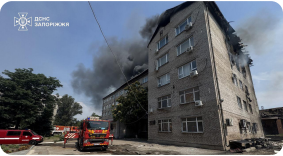
Image: State Emergency Service of Ukraine (via Wikimedia Commons) / CC BY 4.0 / Image Cropped