
Jasmine Comanescu
What’s your favourite scary movie?
If you tend to gravitate towards slasher films, tongue-in-cheek humour, and satirical storytelling, the Scream franchise has undoubtedly made its way onto your radar.
Audiences, myself included, were drawn to the way the original film acted as a love letter to horror — filled with references and commentary on genre tropes, all while not taking itself too seriously.
But beyond the meta-commentary, Scream also worked because it was simply good.
Now, seven films in, does that still hold true — or has it become too close to the very thing it once mocked?
Scream 7 faced controversy long before it hit screens.
Actress Melissa Barrera, a central figure and final girl in the previous two films, was removed from the project following her public support for Palestine — comments that Spyglass Media Group labelled antisemitic.
The backlash was immediate.
Soon after, co-star Jenna Ortega also exited the film. Initially attributed to scheduling conflicts, she later confirmed in a 2025 interview with The Cut that Barrera’s departure — along with the loss of the film’s directors — played a major role in her decision.
In response, Scream 7 leans heavily on nostalgia.
More so, arguably, than any instalment before it.
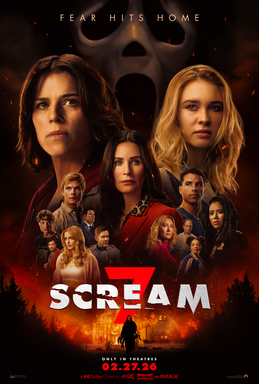
Its biggest draw is the return of Neve Campbell as Sidney Prescott, absent from the sixth film, alongside Matthew Lillard reprising his role as Stu Macher.
To the film’s credit, both deliver.
Campbell brings emotional weight to Sidney’s trauma while retaining the strength that made her one of horror’s defining final girls. Her role as a mother adds a new layer of vulnerability — one that sharpens the threat of Ghostface, a villain who remains terrifying without ever needing supernatural power.
But the film struggles to balance past and present.
Lillard’s return is engaging, yet the attempt to merge that chaotic, old-school energy with modern elements — including FaceTime — creates a noticeable tonal clash.
The use of AI and deepfakes is a compelling idea on paper.
On screen, however, moments like watching a frenzied killer pause to hit “end call” undercut the tension, pulling the audience out of the experience.
The biggest issue comes with the reveal.
Rather than building towards something coherent, the film leans on red herrings and shock value.
The result feels less like a satisfying twist — and more like a misstep.
As a straightforward horror film, Scream 7 works.
The gore is plentiful. The kills are brutal — some of the most intense in the franchise. And the character dynamics are, for the most part, engaging.
But as a Scream film, it falters.
Perhaps doomed from the outset, it relies too heavily on nostalgia and not enough on its own story.
It’s not a bad film.
But it comes dangerously close to feeling like a Stab movie — an imitation of the very thing it once set out to critique.