
Connor Holland
Ealing Studios’ idiosyncratic blend of satire and black comedy make their films stand the test of time.
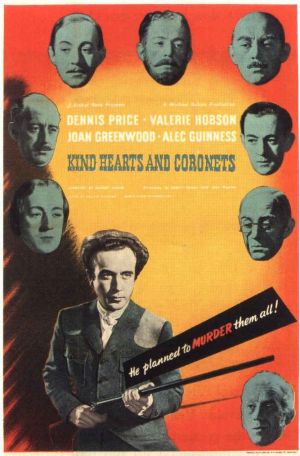
Released in 1949, Kind Hearts and Coronets follows the homicidal life of Louis Mazzini as he seeks to exact vengeance on his cruel aristocratic family, the D’Ascoynes of Chalfont, after they disowned his mother for marrying an Italian (an Italian!) opera singer.
When the D’Ascoyne’s refuse her a place in the family vault after her death, the young Mazzini is set on the path of revenge to reclaim what had been denied him – the Dukedom of Chalfont.
Yet this is not merely a revenge flick with some black comedy sprinkled throughout, but a carefully crafted social critique of British society.
Mazzini, wryly portrayed by Dennis Price, is the epitome of the British antihero; you cannot help but root for him as he goes about swindling and dispatching the heartless D’Ascoyne family.
Robert Hamer creates a fascinating counterpoint between our desire to see Mazzini stick it to these arrogant prigs -aided by Price’s delightfully sardonic narration: ‘I must admit he exhibits the most extraordinary capacity for middle age that I’ve ever encountered in a young man of twenty-four’- and the increasing violence of his murderous methods.
For 1949 the blatant depiction of violent death is shocking (though admittedly pittance for our day), Mazzini’s increasing zeal at reaching his goal is accompanied by our own mounting horror as amusing murder becomes cold killing.
Mazzini is trapped in a system he cannot break out of; his desire for vengeance on his cruel family means he must become as heartless as they are.
The downright bizarre aristocratic culture is similarly portrayed with sincere critique and hilarious absurdity.
Alec Guinness portrays not one, not two but eight members of the D’Ascoyne family, giving eight unique views on the madness of aristocratic life: from arrogance to naivety, pride to hubris.
His performances undoubtedly get the best laughs, always at his character’s expense.
He masterfully gets us to utterly loathe the family through Ethelred D’Ascoyne, The Duke, and Ascoyne D’Ascoyne, the youngest son, yet feel deep sympathy for them.
Henry D’Ascoyne’s kindly nativity is exploited by Mazzini resulting in his death through his beloved hobby.
At the moment of Henry’s death Mazzini is talking to Edith, his internal narrator remarking: ‘I could hardly point out that Henry now had no time left for any kind of activity, so I continued to discuss his future’.
Mazzini’s cruelty is fully exposed, and we must ask ourselves, who is the real monster here?
This murky morality is what makes this film so great.
Whilst rightly lambasting the ridiculousness of these distant people, living in their own world of castles, titles and coronets, it also humanises them; they are not mere caricatures but real people who are being murdered in cold blood.
The brilliance of this film is it can be enjoyed simultaneously as a hilarious comedy, a biting satire and a sharp critique of British society thanks to artful writing, adept performances and expert directing.
This style of satirical societal critiques is something which our all too serious modern world could do with more of.
It is a shame Mr. Powell’s rebranded remake looks to be a pedestrian thriller, having no less than three ‘you’re actually the killer?!’ jokes just in the trailer, without any of the social critique which elevates Harmer’s film beyond an amusing revenge flick.
After all, it’s not as if sharp social divisions have become increasingly extreme in our own day, right?
‘Was Lord Tennyson far from the mark when he wrote: kind hearts are more than coronets?’